Communication is what keeps a marriage working day to day. It’s how two people solve problems, share what they need, and feel understood. When it weakens, even small disagreements start to feel personal. For couples who keep hitting the same walls, a marriage counsellor in Sarjapur can help them slow down, listen properly, and find a way of talking that works for both of them.
Most couples don’t stop communicating overnight. Long commutes, demanding jobs, a new baby or ageing parents slowly squeeze conversations down to schedules and to-do lists. Then one day a comment about the dishes turns into an argument about respect, and neither person is quite sure how they got there. The good news is that these patterns are learned, which means they can also be unlearned.
Below, we look at why communication matters so much, the warning signs worth noticing, and how counselling can help couples talk to each other again.
Why Communication Is the Foundation of a Healthy Marriage
Good communication isn’t about never arguing. Every couple disagrees. What matters is how those disagreements are handled, and whether both partners walk away feeling heard rather than defeated.
Psychologist John Gottman spent decades studying couples. He identified four patterns that tend to damage marriages most: criticism, contempt, defensiveness and stonewalling. Contempt, which shows up as eye-rolling, sarcasm or mockery, was the strongest warning sign of all. It mattered more than how often a couple fought. In other words, the tone of a conversation often matters more than its topic.
That’s actually encouraging. These are habits, not fixed personality traits, and habits can be noticed and changed with the right support.
Common Communication Problems Couples Face Today
For working couples in Bengaluru, the triggers are usually practical. A study of 238 Bangalore marriages found that money, household chores, time management, parenting and in-law relationships were among the most common sources of arguments in dual-career homes.
The topics themselves are ordinary. It’s the way they get discussed that causes the damage. A few patterns show up again and again:
- Opening a conversation with blame (“You never help”)
- Going silent or walking away mid-discussion
- Assuming what the other person thinks instead of asking
- Talking while half-looking at a phone
- Avoiding difficult topics until they explode
Most couples will recognise at least two of these. The real question is when they’ve become stuck.
When Should Couples Consider Marriage Counselling?
Couples should consider counselling when the same arguments keep repeating without resolution, or when one or both partners consistently feel unheard. You don’t need to be on the edge of separation to benefit.
A few signs it may be time:
- You have the same fight in different forms
- Conversations feel tense, or you avoid them altogether
- You feel more like flatmates than partners
- A big change, such as a new baby, a job loss or caring for a parent, has shifted the balance
Counselling also works well as prevention. Many couples come in before marriage or during early parenthood simply to build healthier habits while things still feel manageable.
How a Marriage Counsellor in Sarjapur Can Help Couples Communicate Better
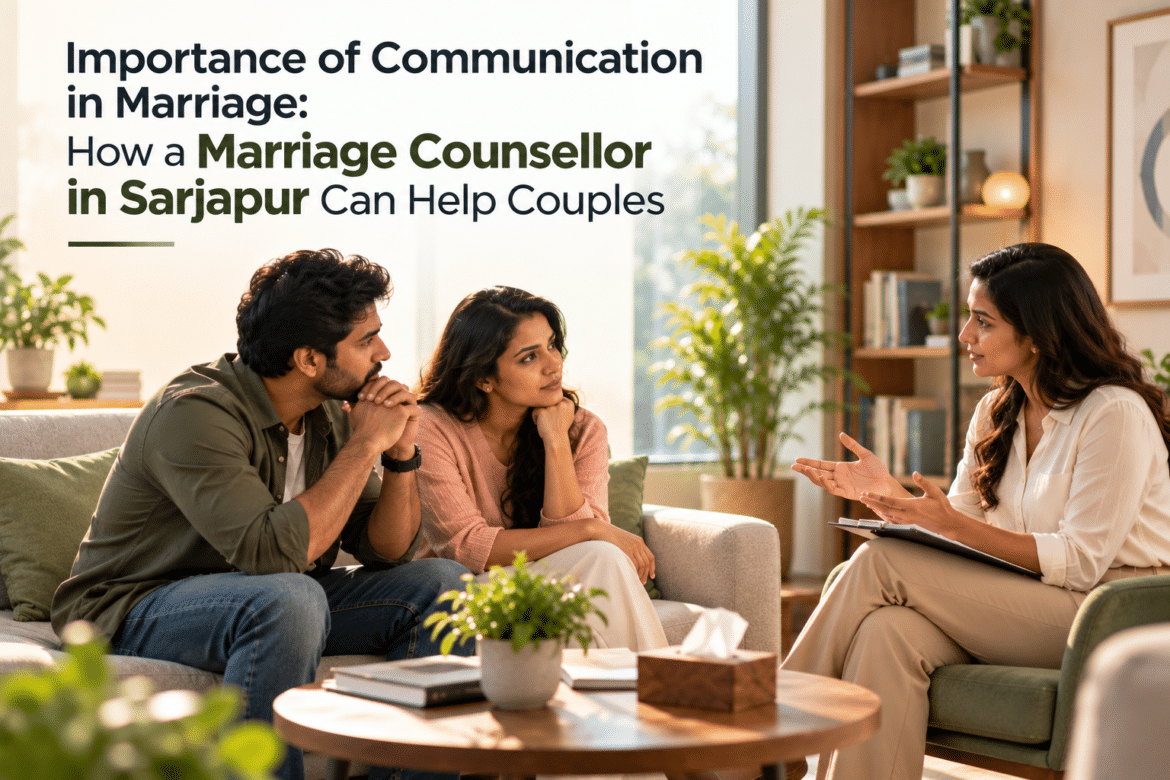
A trained counsellor doesn’t take sides or hand out verdicts. Their job is to help both partners understand what’s happening between them and give them tools to change it. That support usually covers a few areas.
A Neutral, Safe Space to Talk
Some conversations are hard to have at home, where old patterns kick in fast. A counselling session slows things down, so each person can speak without being interrupted or shut down.
Spotting Unhelpful Patterns
Couples are often too close to the problem to see its shape. A counsellor can point out cycles that neither person had noticed, such as one partner pushing to talk while the other withdraws.
Learning Practical Communication Skills
This includes listening to understand rather than to reply, and raising concerns gently. It also means learning how to repair things after a conflict instead of letting resentment quietly build.
Support Through Life Transitions
New parenthood, career pressure and caring for elderly parents all put strain on a marriage. Counselling helps couples adjust together rather than drift apart under the weight of it.
What Happens in Relationship Counselling in Sarjapur?
Relationship counselling in Sarjapur usually begins with understanding your story: what brought you in, what you’ve already tried, and what you’d like to change. Most people feel nervous beforehand and a little lighter afterwards.
Sessions are confidential, and the counsellor sets ground rules so both partners feel safe. If one partner isn’t ready to attend, individual sessions can still help. When one person changes how they respond, the whole dynamic often shifts. Working with a marriage counsellor in Sarjapur also means you don’t have to cross the city for every appointment, which makes it easier to stay consistent.
Finding the Right Support Close to Home
When you search for marriage counselling near me, it’s tempting to pick the first name that appears. It’s worth taking a little more care. Look for qualified psychologists or counsellors, and ask about their experience working with couples. Check, too, that sessions are available in a language you’re both comfortable with.
Comfort matters as much as credentials. Both of you should feel you’re being treated fairly. Practices like Shubha Counselling Services also support individuals, new mothers, children, elderly family members and working professionals. That wider support helps when relationship stress is tied to pressures elsewhere in the family.
Conclusion
Communication shapes almost every part of married life, from how decisions get made to how safe each partner feels sharing what’s on their mind. When conversations keep breaking down, a marriage counsellor in Sarjapur can help couples understand their patterns, learn practical skills, and rebuild the sense of being on the same team.
Reaching out isn’t an admission that the marriage has failed. If anything, it shows that both of you think it’s worth the effort. The couples who do well are rarely the ones who never struggle. They’re the ones willing to learn how to talk to each other again.